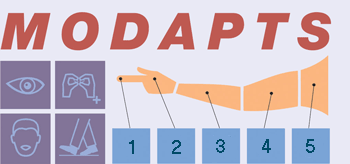
MODAPTS is a simple and descriptive language
for understanding work, tasks or activities.
The time needed to carry out any job is determined in
large part by what the person performing the job has
to do. MODAPTS provides a code for describing any work
action and provides a time, a comfortable time, for
that action. The letters used in MODAPTS codes have a
clear association with the names of the actions they
describe. They are easier to remember than those in
comparable systems, yet they still retain the same
level of accuracy.
The figures used in MODAPTS codes show the time
needed for the part of the body involved to carry out
the necessary action at a comfortable pace, which
could be maintained as part of a work cycle for a full
working day. All MODAPTS times are multiples of 0.129
seconds MODAPTS is a form of shorthand, or a succinct
language for describing the sequence of body actions
involved in carrying out particular work. It provides
a script for how the work is done, action by action.
MODAPTS can be used to:
• establish a reasonable and sustainable time to
complete a job or a proposed job;
• determine the best method and workplace layout to
perform a given task
• balance the flow of work
• cost a job,
• develop standard operating procedures and work
instructions
• provide a framework for the analysis of actions and
postures in the workplace
• match workers' best actions with appropriate jobs
• quantify the degree of disability for particular
tasks
MODAPTS stands for MODular Arrangement of
Predetermined Time Standards. It is one of the more
recently developed Predetermined Motion Time System
(PMTS) but it differs from others in that it focuses
on the body part doing the moving rather than the
distance covered by the body part of the object being
handled. This difference contributes to MODAPTS speed
of use, when matched with comparable systems. .
MODAPTS is based on empirical studies done in the
late 1960s and 1970s with hundreds of people in
different work situations, covering many different
aspects of work. These studies were guided by Chris
Heyde. The goal of these studies was to collect
unexceptional performances, ie natural speeds,
unremarkable for being fast or slow.
Various versions of MODAPTS have been translated into
Japanese, German, Dutch, Chinese, Korean, Spanish and
Russian. MODAPTS is currently used in many countries
and by some large corporations such as Ford the United
States. The current HEYDE'S MODAPTS book has been
translated into Japanese by the Japan Institute of
Plant Maintenance. MODAPTS is also used by
occupational therapists in Australia, New Zealand,
South Africa, the USA and the United Kingdom.